
Training your brain is possible, and it isn’t just a figure of speech: the adult brain changes with practice, just like the body. In this article I’ll tell you what science has shown (London taxi drivers, jugglers, physical exercise), the three rules of physical training that also apply to the mind, and a fourth that applies only to the mind. Then, where dynamic neurofeedback fits in, what the evidence supports and what it doesn’t, and four things you can start today without setting foot in a practice.
Everyone understands that a body can be trained: nobody expects to run ten kilometers on day one, or is surprised to lose fitness after a winter on the sofa.
With our minds, though, we still think in fixed terms. I’m scatterbrained. I’ve always slept badly. That’s just how I am.
It isn’t a matter of personality. It’s that almost nobody has explained to us that there’s something in there that also changes with practice.
The brain trains like a muscle: “the phrase everyone repeats and almost nobody backs up”
“The brain trains like a muscle” has become a slogan. It’s used to sell brain-game apps, supplements and productivity courses. And after being repeated so often without explanation, it has ended up sounding like a motivational quote.
But there’s something real and well documented behind it. It’s worth looking at calmly, because it changes quite a bit how you understand what’s happening to you when you’ve been exhausted for months.
Neuroplasticity: what science does show
In 2000, a team at University College London scanned the brains of the city’s taxi drivers. To get their licence, these drivers spend years memorising the layout of twenty-five thousand streets. The result: their posterior hippocampus, an area closely involved in spatial memory, was larger than that of comparable people, and the longer they had been driving, the larger it was.
It could be explained the other way around: maybe people with that kind of brain are the ones who choose the job. So eleven years later the same team ran the honest experiment. They followed seventy-nine trainees for three or four years while they studied. Only the brains of the thirty-nine who passed changed. Those who studied but didn’t master it, didn’t.
In parallel, another group taught adults who had never tried it to juggle. Three months later, the grey matter in areas that process visual motion had increased. With a second part that’s almost never mentioned: when they stopped practising, the change began to disappear.
It isn’t a pretty metaphor. The adult brain physically reorganises itself when it learns. And it stops doing so when you stop.
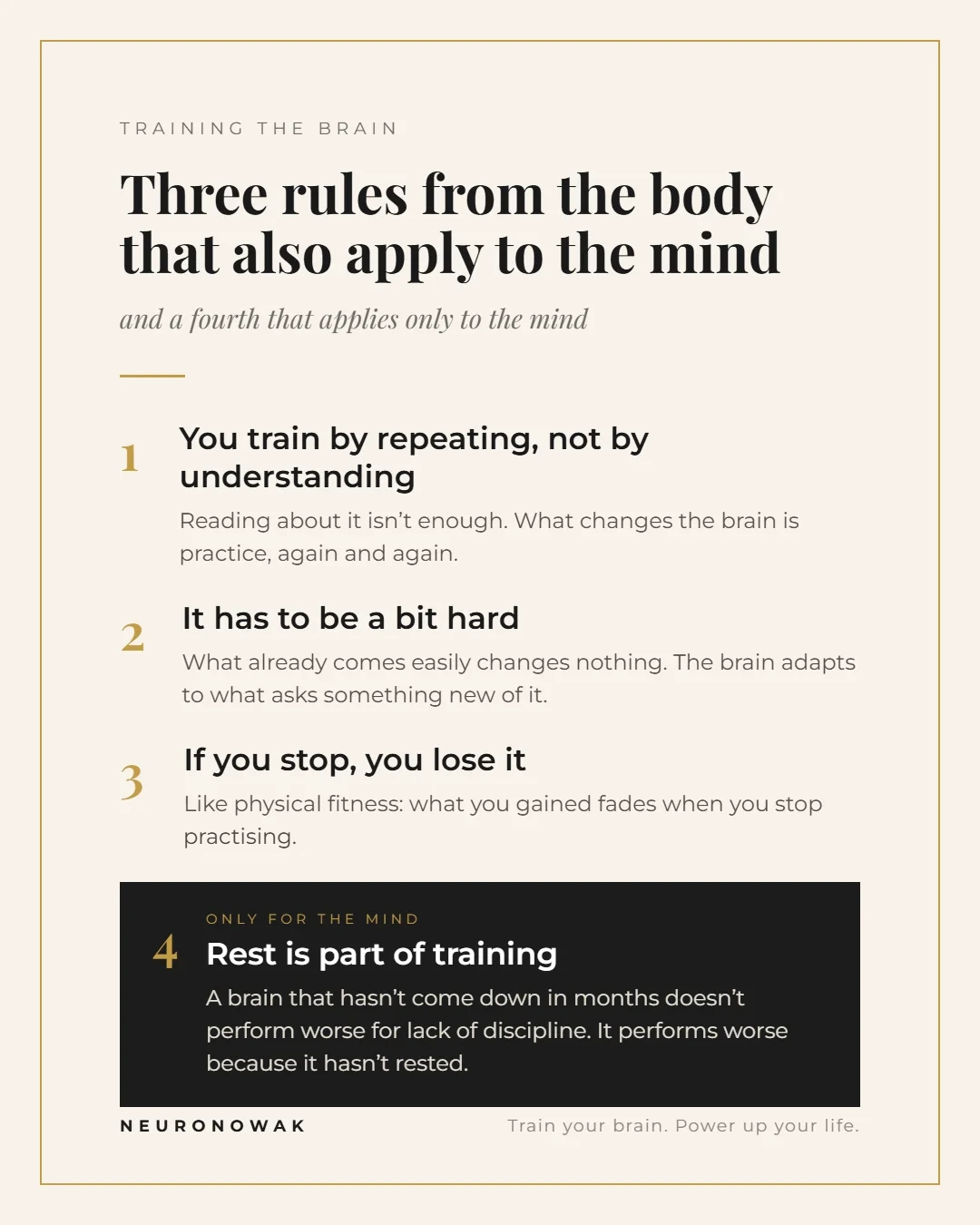
Three rules for training your brain that you already know from your body
You train by repeating, not by understanding. Reading about breathing doesn’t regulate your nervous system, just as reading about swimming doesn’t teach you to swim. What produces change is repetition.
It has to be a bit hard. This is the most uncomfortable finding: in motor learning studies, structural changes appear while the person is acquiring the skill, not once they’ve mastered it. Continuing to do well what you already do well doesn’t move much. That’s why puzzles you’re already good at are entertaining but don’t train much.
You lose it. The same juggling study showed the reversal when practice stopped. Just like the body.
And there’s a fourth that applies only to the mind, and it’s the one most people need to hear: rest isn’t the break between training, it’s part of it. A brain that has been in sustained activation for months doesn’t perform worse for lack of discipline. It performs worse because it hasn’t come down.
What if your mind hasn’t come down in months?
A session takes about fifty minutes and there’s nothing to get right during it. If you’d like to know whether this fits your situation, message me and I’ll tell you straight, including if I think it doesn’t.
Dynamic neurofeedback: where does it fit in brain training?
In a single sentence: dynamic neurofeedback records your brain’s electrical activity and gives it back to you in real time, through sound, so that your own brain notices its abrupt shifts and readjusts.
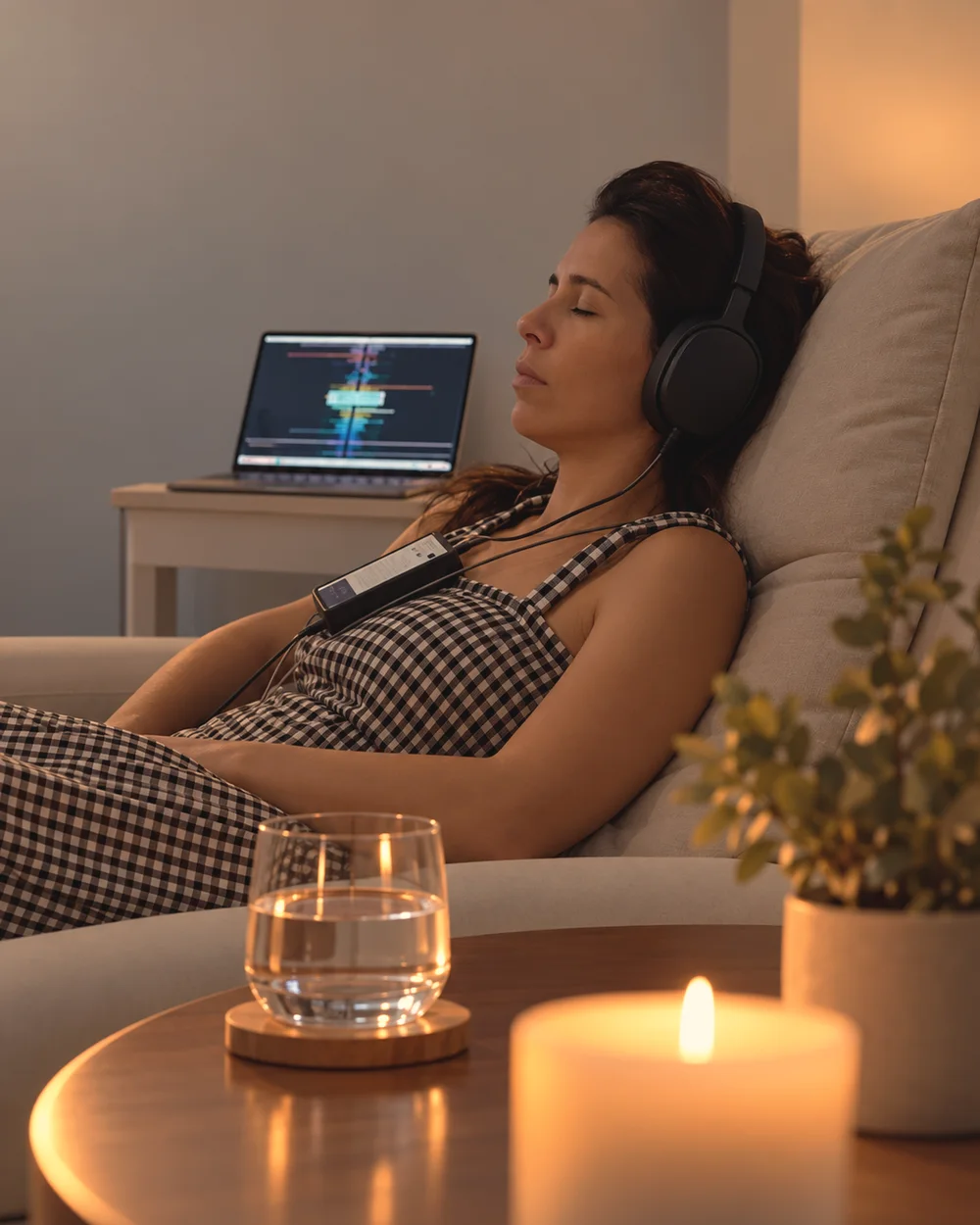
It doesn’t send electricity. It doesn’t stimulate. There’s nothing you have to get right during the session. You sit down, listen to music, and the only thing that happens is that your brain receives information about itself that it normally doesn’t have. If you’d like the details of what a session is like minute by minute and how many you need, I covered it all in this article about sessions.
To stay with the comparison: it isn’t the coach shouting a workout at you. It’s the gym mirror. It doesn’t tell you what to do; it lets you see yourself, and you make the correction without thinking about it.
Neurofeedback and scientific evidence: what holds up and what doesn’t yet
This is where this article parts ways with almost everything you’ll read on the subject.
The neuroplasticity research I’ve just described, the taxi drivers, the juggling and the physical exercise, is solid. But it’s research on learning. None of those studies looked at neurofeedback. Using them as proof that neurofeedback works would be cheating, and in this industry it happens all the time.
What the specific evidence says, as of today:
- For ADHD, the most recent and most rigorous meta-analysis, published in JAMA Psychiatry in 2025 and covering thirty-eight clinical trials, finds no significant benefit when the person rating the symptoms doesn’t know which treatment each child received. Neurofeedback doesn’t hold up as a stand-alone treatment for ADHD.
- For insomnia, a double-blind study published in Brain concluded that neurofeedback showed no specific efficacy beyond the placebo effect. For chronic insomnia, the European guideline puts cognitive behavioural therapy first, not this.
- Dynamic neurofeedback, the kind I use, has no systematic reviews or sham-controlled trials in high-impact journals. There are pilot studies and qualitative work. That doesn’t mean it doesn’t work: it means it isn’t proven, and I’d rather tell you myself than have you find out on your own.
Why am I telling you this if it’s how I make my living?
Because what I do see every week in my practice is real: people sleeping through the night again, no longer waking at three in the morning, getting their spark back. Part of that benefit may come from non-specific factors: expectation, the hour of calm, the fact that someone is with you. Those factors are also part of what you receive, and I don’t consider them a flaw.
What I won’t do is promise you a cure, or show you a success rate without telling you where it comes from.
How to train your brain at home: four things you can do without setting foot in my practice
Because training your brain starts long before any device:
- Protect the hour before bed the way you protect a gym session. It isn’t a luxury: it’s where your nervous system comes down.
- Learn something you’re bad at. A language, an instrument, a dance. The initial clumsiness isn’t the price of learning: it’s exactly the part that trains.
- Move three times a week. It’s by far the best-documented thing there is for adult brain health.
- Stop reading exhaustion as a character flaw. Living on alert isn’t normal. It’s just very common.
Let me pause on the third one, because it’s the one most people skip. In 2011, a team at the University of Pittsburgh randomly assigned one hundred twenty older adults to two groups: one walked briskly three times a week, the other did stretching. After a year, the hippocampus of the walking group had grown by about 2%, the equivalent of reversing one or two years of age-related loss, along with a real improvement in spatial memory. The stretching group kept losing volume, as expected.
No device I have in my practice is as well documented as going for a brisk walk. Start there.
Before anything else, there’s a twenty-minute chat where I just listen and tell you whether this is a fit. Free and no strings attached. → Message me
Where to start
If you recognised your week while reading this, start with the free option: the FAQ answers everything straight, including the awkward questions.
And if you’d like to try this business of sitting down, listening to music and having nothing to get right for an hour, let’s talk and I’ll explain it without rushing. No prior diagnosis, no three-hundred-euro assessment before you start: the prices are published.
NeuroNowak · Train your brain. Power up your life.
Frequently asked questions
Can you train your brain at any age?
Yes. Neuroplasticity doesn’t expire: the juggling study was done with adults, and the exercise study with people aged sixty and over. What changes with age is the speed, not the possibility.
Do brain-game apps work?
Not much, and it’s worth knowing. The most comprehensive review of brain training found that those games mostly make you better at those same games, and that transfer to everyday life, memory, attention or work is barely demonstrated. Truly learning something new trains far more than any app.
How long until a change shows?
In learning studies, weeks or months of regular practice. In my practice, the benchmark I give is the same for everyone: if nothing has happened after eight or ten sessions, this isn’t for you and I’ll tell you so.
Does neurofeedback replace therapy or medication?
No, and be wary of anyone who says otherwise. It’s a complement. Any decision about medication is made with your doctor, not here.
Sources
- Maguire EA, Gadian DG, Johnsrude IS et al. Navigation-related structural change in the hippocampi of taxi drivers. PNAS, 2000. View study
- Woollett K, Maguire EA. Acquiring the Knowledge of London’s layout drives structural brain changes. Current Biology, 2011. View study
- Draganski B, Gaser C, Busch V et al. Neuroplasticity: changes in gray matter induced by training. Nature, 2004. View study
- Driemeyer J, Boyke J, Gaser C et al. Changes in gray matter induced by learning — revisited. PLOS ONE, 2008. View study
- Erickson KI, Voss MW, Prakash RS et al. Exercise training increases size of hippocampus and improves memory. PNAS, 2011. View study
- Simons DJ, Boot WR, Charness N et al. Do brain-training programs work? Psychological Science in the Public Interest, 2016. View review
- Westwood SJ et al. (European ADHD Guidelines Group). Neurofeedback for Attention-Deficit/Hyperactivity Disorder: a systematic review and meta-analysis. JAMA Psychiatry, 2025. View study
- Schabus M, Griessenberger H, Gnjezda MT et al. Better than sham? A double-blind placebo-controlled neurofeedback study in primary insomnia. Brain, 2017. View study
- Riemann D, Espie CA, Altena E et al. European insomnia guideline. Journal of Sleep Research, 2023. View study
- Ros T, Enriquez-Geppert S, Thibault RT et al. Consensus on the reporting of clinical neurofeedback studies (CRED-nf). Brain, 2020. View study
The NeuroNowak blog
Get every new article in your inbox
One every week or two. How the brain works, sleep, stress and focus, with real science. No spam, and you can unsubscribe whenever you like.
Share
WhatsApp · LinkedIn · Facebook
Keep reading
Neurofeedback sessions: what they’re like, how long they last and how many you need
What a session is like minute by minute, what it feels like and how many you need.