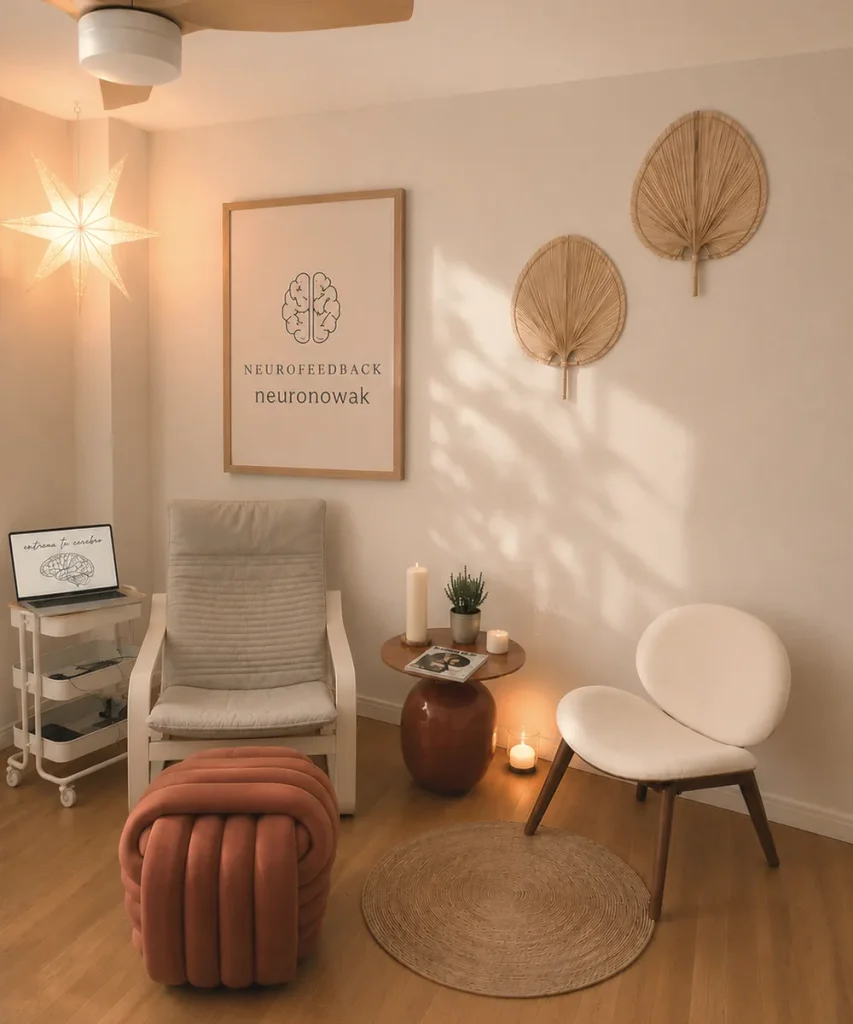
Neurofeedback sessions always raise the same questions before people book: what exactly happens in there, whether it hurts, whether you have to do anything and how long it takes. And above all, how many you need before you notice something. I answer them all here: what neurofeedback does, what a session looks like minute by minute, what it feels like, how many sessions you need (usually between 10 and 20), what the research says, what it costs and where to train, in La Cala del Moral (Málaga).
I’ll tell you how it really is, without selling you anything. Neurofeedback sessions are nothing like a doctor’s appointment or a therapy session: you sit down, close your eyes and listen to music. Your brain does the work. We don’t send electricity into you, you don’t have to concentrate on anything and you don’t need to arrive with a diagnosis under your arm.
Everything is in this article: what a session is like minute by minute, what it feels like, how many are usually needed, what the research says and doesn’t say, what it costs and what’s worth knowing before you start.
1. What neurofeedback does, in plain words
Put simply, neurofeedback is a gym for your brain. While you sit comfortably, the system reads your brain activity in real time and gives it back to your own brain as information. With that information, the brain learns to self-regulate: to find its balance on its own.
It doesn’t send electricity. Nothing goes into you. You don’t need a prior diagnosis. You just sit down, close your eyes, and your brain does the work. It’s non-invasive, drug-free and based on the brain’s natural ability to change, what neuroscience calls neuroplasticity, and it doesn’t expire with age.
The gym comparison isn’t just decoration. Nobody goes to the gym once and comes out different. And nobody concentrates on making their muscles grow: the body does that on its own while you exercise. The same happens here, with the advantage that the exercise consists of sitting and listening to music.
2. What a neurofeedback session is like, minute by minute
You arrive and get comfortable. An armchair, soft light, no white coats or clinical atmosphere. We chat for a moment about how you’re feeling and how your week went.
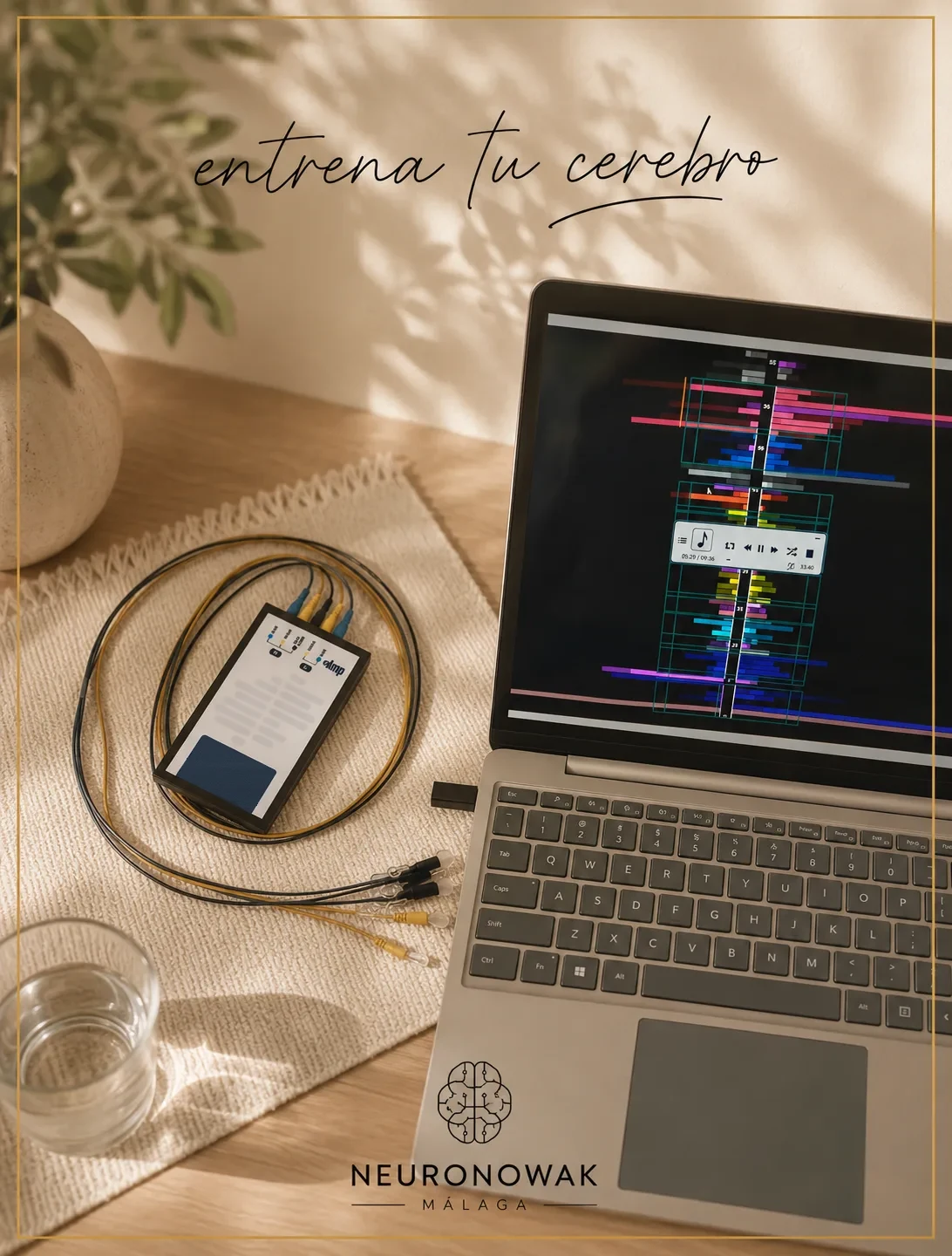
The sensors go on. Five in total: two on the scalp and three reference sensors on the ears, with a conductive paste that washes off with water afterwards. The sensors only read. They don’t emit anything. It’s the question I get most, and the answer is always the same: no.
The music starts. You close your eyes and listen. Every now and then the sound cuts out for a split second. That tiny pause is the “feedback”: it’s the system’s way of telling your brain “you just changed state.” Nothing more. It doesn’t force you to relax or stimulate you.
Your brain does the rest. Without any effort on your part, it recalibrates. Thousands of times per session. That’s why there’s nothing to get right or wrong: you can fall asleep, think about your grocery list or think about nothing. It works the same.
We finish and talk. The sensors come off, everything is cleaned, and we talk for a couple of minutes about how it went.
Length: the music lasts 33 minutes. Counting setup and the time at the end, plan on about 50 minutes for the whole visit.
3. What it feels like during and after
During the session, most people describe something like a nap with an awake mind. Many sum it up like this: it’s the first moment all day when I finally stop. Some people fall asleep. Some leave with an unusual feeling of calm, like after a massage, but on the inside.
Afterwards, the most common thing is not to notice anything dramatic. And that’s normal: neurofeedback doesn’t produce a “high.” What people usually tell me, after a few weeks, are changes like these:
- Sleeping through the night, or falling back asleep faster after waking up in the early hours.
- Your mind taking less time to switch off at night.
- Less reactivity: the same things happen, but they don’t get to you the same way.
- More sustained focus, without the effort of constantly forcing your attention.
And yes, some people don’t notice anything. It happens, and it’s part of an honest conversation.
4. How many neurofeedback sessions you need
It’s the question I’m asked most, and the honest answer is that it depends on the person and what they’re looking for. What I can tell you is how it usually goes in my practice.
| Stage | What usually happens |
|---|---|
| Sessions 1 to 3 | Adaptation. The brain gets familiar with the system. The first thing to shift is usually sleep, even if only a little. |
| Sessions 4 to 10 | The changes start to be noticeable: rest, reactivity, clarity. The people around you often notice before you do. |
| Sessions 10 to 20 | What you’ve gained holds better from one session to the next. This is where the process settles in. |
| After that | Maintenance, at a much more spaced-out pace, or wrapping up the process. |
The usual frequency is one or two sessions a week. Closer together doesn’t speed up the process, and too far apart makes it hard to settle in. That’s why we work with 10- and 20-session packages: it isn’t a sales strategy, it’s that short processes rarely get the chance to consolidate.
What if you saw it for yourself in a session?
About fifty minutes, with nothing to get right. I’ll tell you beforehand whether I think it fits your situation, and also if I think it doesn’t.
5. Who it works best for
In my practice, I mostly see three kinds of people.
The one who’s running on empty. Early forties, mind always full, sleeps so-so, functions fine on the outside but is at the limit on the inside. Hasn’t hit breaking point, but knows something isn’t right. Here neurofeedback helps to wind down and get real rest back.
The one who wants to go a step further. Already looks after their mind, meditates, exercises or has done therapy, and isn’t looking to fix anything broken but to fine-tune: more focus, more clarity, better performance. The brain, like the body, can be trained too.
The parent looking for help for their child. A child with ADHD, attention difficulties or who gets frustrated with everything. They’ve been to several places and are looking for something that helps, ideally without more medication.
On that foundation of a more regulated nervous system, we support work on rest and insomnia, anxiety and stress, mental load, ADHD in children and adults, and clarity, calm and performance in general.
We don’t replace your doctor or your psychologist. We work on the starting point on which everything else works better.
6. What the research says
I’ll lay my cards on the table, because I think that’s what you deserve before spending a single euro.
Neurofeedback has been studied for decades, and the most research has built up around its use for ADHD. A systematic review with meta-analysis published in European Child & Adolescent Psychiatry found that improvements in inattention and hyperactivity held between six and twelve months after training ended (Van Doren, Arns et al., 2019).
That’s the finding that interests me most, because it marks the difference between temporary relief and learning. And it makes sense if you think about how this works: nothing is administered here, a capacity is trained. And trained capacities don’t disappear when you stop training, just as you don’t forget how to balance on a bike.
That said, evidence doesn’t mean guarantees. The response is personal, the changes are gradual and some people notice little. That’s why you won’t find promises of results here. You’ll find a training proposal, an explanation of how it works and a commitment: if you don’t notice anything after a few sessions, we’ll talk about it frankly instead of adding more sessions.
7. What neurofeedback isn’t
Almost as important as what it is.
- It isn’t a medical treatment. We don’t diagnose or treat medical conditions. It’s training focused on well-being and performance, complementary to therapy or medical care, never a substitute.
- It doesn’t send anything into your brain. The sensors record, they don’t emit. No current, no magnets, no substances.
- You don’t need to be struggling to come in. Many of the people who train here are doing perfectly well and come to fine-tune.
- It isn’t hypnosis or suggestion. You don’t have to believe anything for it to work, and we don’t ask you to do anything mentally.
- There are no guaranteed results. Anyone who promises them, in this or anything else, is selling you smoke.
8. How much a neurofeedback session costs
I’ll say it clearly, because it’s information people look for and many centres hide.
A single session costs €60, and the 30-minute conversation beforehand is free. If you’re hesitant to start, the first time you can do a discovery session for €35. From there, since the process works through continuity, most people work with packages: the 10-session package is €460 (€46 per session) and the 20-session package is €840 (€42 per session).
You’ll find all the details on the pricing page. And if you’d like to talk it over before deciding, I’ll call you at no cost and we’ll go through it.
9. Where to train, and in what language
We’re in La Cala del Moral (Málaga), on the eastern Costa del Sol.
Being close isn’t a minor detail. This works through consistency, week after week. Having the centre fifteen or twenty minutes away, not an hour down the highway, is exactly what keeps a process going instead of stalling at the third session.
And if you’re part of the coast’s international community, you can do it in your own language here: English, French or Spanish. Le neurofeedback près de chez vous, en français. Neurofeedback cerca de casa, en español.
10. Five things worth knowing before you start
- Don’t come in a hurry. If you need results by next week, this isn’t for you. It’s training, and training takes time.
- Don’t quit at the third session. That’s exactly when you don’t notice much yet and it’s easy to think it isn’t working. The interesting part usually starts after.
- Come with clean hair and no products. Hairspray, oils or leave-in conditioner make it harder for the sensors to read.
- Write down what changes. Changes are gradual and it’s easy to forget how you were before. Two lines a week on your phone are enough.
- Say so if you don’t notice anything. I’d a thousand times rather review the plan with you, or tell you this isn’t for you, than sell you another package.
Did you recognise yourself in any of this?
Let’s talk, no strings attached. I’ll call you at no cost, listen, and we’ll see together whether neurofeedback is a good fit for you.
Frequently asked questions about neurofeedback sessions
How long does a neurofeedback session last?
The music lasts 33 minutes. Counting setup and a few minutes at the end to talk about how it went, the whole visit takes about 50 minutes.
How many neurofeedback sessions are needed?
It depends on each person and goal. Most people work with packages of 10 or 20 sessions, once or twice a week, because stable changes need continuity.
Does it hurt or have side effects?
No. The sensors only read brain activity, they don’t send anything. The session is so comfortable that many people relax deeply or even fall asleep.
Do I have to do anything during the session?
Nothing. No concentrating, no relaxing on purpose, no thinking about anything in particular. Just sit and listen. The learning happens without you stepping in.
Is neurofeedback a medical treatment?
No. It’s brain training focused on well-being and performance. We don’t diagnose or treat medical conditions: it complements therapy or medical care, it doesn’t replace them.
Where can I book a session?
At NeuroNowak, in La Cala del Moral (Málaga). We work by appointment and always start with a 30-minute conversation, at no cost.
Do you work in English or French?
Yes. Aurélie is a native French speaker and works naturally in English, French and Spanish with the Costa del Sol’s international community.
NeuroNowak · Train your brain. Power up your life.
The NeuroNowak blog
Get every new article in your inbox
One every week or two. How the brain works, sleep, stress and focus, with real science. No spam, and you can unsubscribe whenever you like.
Share
WhatsApp · LinkedIn · Facebook
Keep reading
Train your brain the way you train your body
What science shows about the learning brain, and what it doesn’t show about neurofeedback.