Waking up at 3 a.m. and not getting back to sleep has a name, sleep maintenance insomnia, and it has an explanation: around that hour sleep gets lighter for everyone, and a brain that never quite lowers its guard uses that moment to switch back on. In this article I explain why it happens at that exact hour, what makes it worse without seeming to, five steps you can try tonight and what the evidence says, including what doesn’t work in our favour.
Lying there with your eyes open at that hour is one of the most frustrating ways to sleep badly. You fell asleep without a problem. Your body is exhausted. And still, in the middle of the night, your mind switches on as if someone had flipped the light.
You look at the clock. You calculate how many hours are left. And that calculation is exactly what finishes waking you up.
If it happens to you often, and almost always at the same time, it isn’t bad luck or a quirk of yours. It has a name, an explanation and a way out. Here’s what sleep science knows today, without alarmism and without promises.
It has a name: sleep maintenance insomnia
There are two main ways of sleeping badly, and they aren’t the same. There are people who can’t fall asleep, and people who fall asleep fine but can’t stay asleep. The second is called sleep maintenance insomnia: waking up in the middle of the night, or too early, and finding it very hard to get back.
The difference matters because the mechanism is different. In the first case the brain can’t start winding down. In the second it starts, but doesn’t stay down.
Why you wake up at exactly 3 a.m.
The hour isn’t random. Sleep isn’t a flat state: it’s organised into cycles of roughly an hour and a half, and each cycle ends with a moment of lighter sleep when we all wake briefly, even though we almost never remember it.
Deep sleep, the hardest to interrupt, dominates the first half of the night. Around three, after two or three cycles, three things happen at once:
- Sleep pressure has already dropped. The chemical need for sleep that builds up during the day has been largely discharged in the first hours.
- Sleep gets lighter. There’s less deep sleep and more light and REM stages, with more transitions between them.
- Your internal clock starts preparing for morning. Cortisol, the hormone that gets us going, begins to rise in the second half of the night.
In other words: at that hour the exit door from sleep is ajar for everyone. The question isn’t why you wake up, but why you don’t get back in.
What’s happening inside: a brain that won’t lower its guard
The best-supported explanation today is the hyperarousal model. According to reviews by Dieter Riemann’s group at the University of Freiburg, people with insomnia show a more activated nervous system than normal, by day and also by night: more fast brain activity during sleep, a higher heart rate, more energy use (Dressle and Riemann, 2023; Riemann et al., 2010).
The stress axis plays a part too. A study at Penn State found that people with chronic insomnia secreted more cortisol and ACTH at night than good sleepers, especially in the late evening and the first part of the night (Vgontzas et al., 2001).
In plain terms: you don’t wake up because you’ve slept enough. You wake up because your brain is still on guard, and as soon as sleep gets lighter, anything will do to switch it back on. It’s a survival mode that made sense at some point and got stuck on.
What’s waking you up?
Not all awakenings are the same. The sleep test is ten questions and a minute and a half: it tells you your rest profile, whether the circle between night and day has already closed, and where to start tonight.
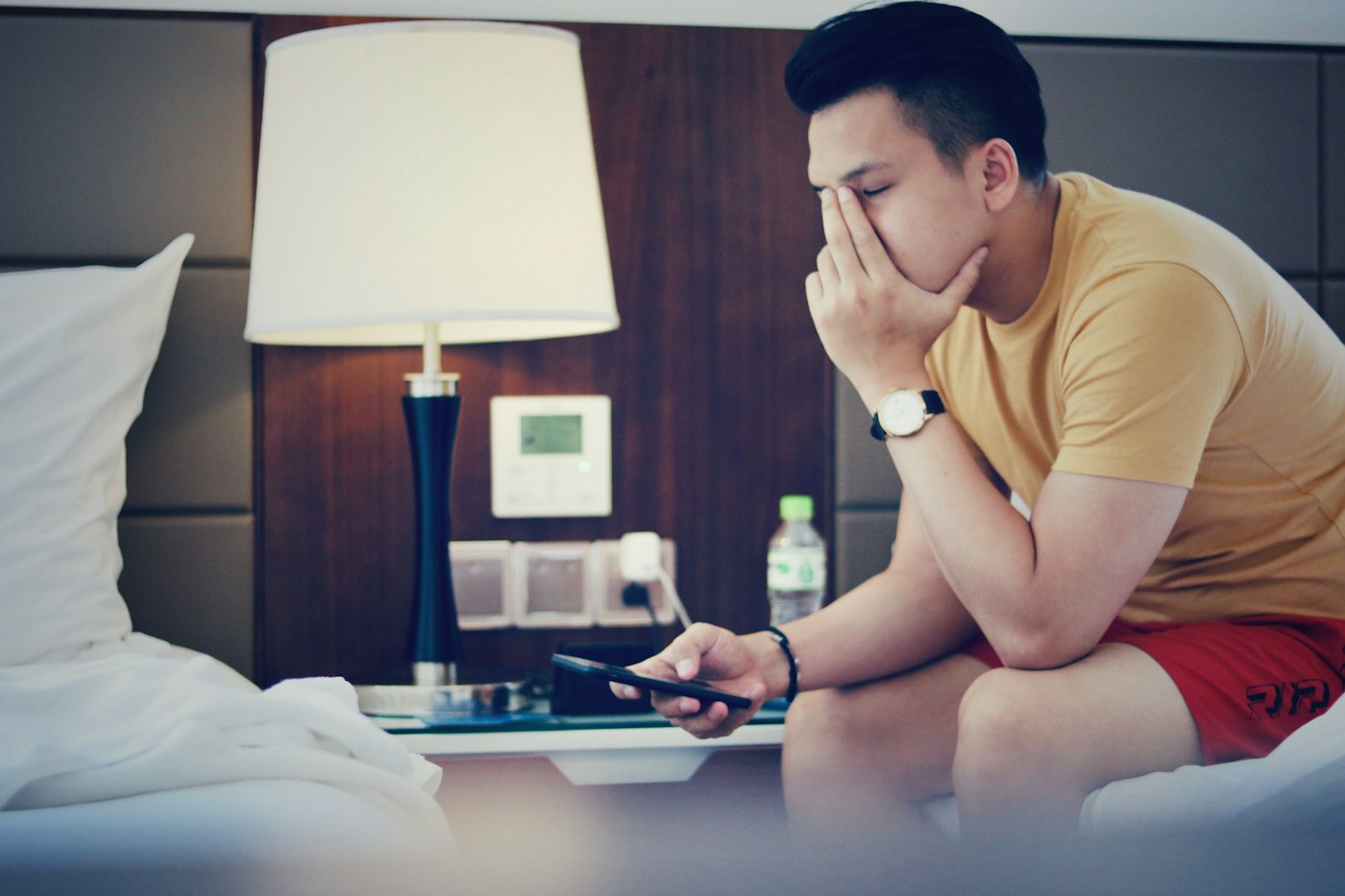
Checking the clock in the early hours: the loop that keeps you awake
There’s one thing almost everyone does that makes it worse: checking the time. In an experiment, people with insomnia who could see a clock while trying to sleep worried more and took longer to fall asleep than those who couldn’t (Tang, Schmidt and Harvey, 2007).
The mechanism is simple. Seeing “3:40” turns a normal awakening into a countdown. The countdown triggers calculation, calculation triggers worry about the next day, and worry is exactly what an already activated brain doesn’t need.
What makes it worse without seeming to
The evening drink. Alcohol helps you fall asleep faster and concentrates a bit more deep sleep at the start. The price comes later: in the second half of the night sleep fragments and there are more awakenings (Ebrahim et al., 2013). Early-morning awakenings are its most common signature.
Staying in bed fighting it. Spending a long time awake in bed teaches your brain that bed is the place for thinking. The more it repeats, the more automatic it becomes.
Making up for it in the morning. Sleeping in after a bad night seems logical, but it shifts your internal clock later and reduces sleep pressure for the next night.
What to do if you wake up at 3 a.m.: five steps for tonight
- Turn the clock around and keep your phone out of reach. If you don’t know the time, there’s no countdown.
- If about twenty minutes go by and you’re still awake, get up. Low light, something boring, no screens. Go back to bed when you feel truly sleepy.
- Name it and let it go. If your mind starts up with to-dos, jot them on a piece of paper on the nightstand. What’s written down stops going round and round.
- Get up at the same time, no matter what. Especially after a bad night. It’s what stops one night from dragging down the next.
- Try a week without the evening drink and compare. It’s the cheapest experiment there is.
Give them three weeks in a row before judging them. If you also snore with pauses in your breathing, have restless legs at bedtime or sleep overtakes you during the day where it shouldn’t, such as while driving, a doctor should look at that before anyone else: those aren’t things that can be trained.
Neurofeedback and insomnia: what the evidence says, including what doesn’t work in our favour
The 2023 European insomnia guideline is clear: the first-line treatment is cognitive behavioural therapy for insomnia (Riemann et al., 2023). If you’ve never tried it, that’s where it’s worth starting.
On neurofeedback, the honest thing is to tell both sides. A double-blind trial published in Brain compared neurofeedback with a placebo in people with insomnia and found no specific difference between them (Schabus et al., 2017). Other studies do describe improvements, and the scientific community has agreed on criteria to make future studies more comparable (Ros et al., 2020). The debate is open and I’m telling you exactly where it stands.
What we do at NeuroNowak is dynamic neurofeedback: sensors read your brain’s electrical activity and, when it drifts from its own rhythm, the music pauses for an instant. That tiny cue is enough for the brain to notice the mismatch and reorganise on its own. It doesn’t induce sleep and doesn’t replace anything. It’s the same idea as training your brain the way you train your body: giving information so the system learns to regulate itself.
What people who come for night-time awakenings usually notice first is almost never more hours of sleep. It’s a feeling of calm. The awakenings become less frequent after that. If you’d like to know what a session is like, it’s explained in what the sessions are like, and the prices are on the pricing page.
Would you rather talk to a person? Book a free 30-minute conversation, at the centre or by video call.
In short
Waking up in the early hours is normal. What isn’t normal is not being able to get back to sleep. Behind it there’s usually a brain that never quite lowers its guard, a clock that turns waking into a countdown and a few habits that feed it without you noticing. Habits can change tonight. The ability to release the brake can be trained.
If you’d like to know where to start, take the sleep test: a minute and a half, and at the end you get the guide for your profile with a fourteen-day plan.
Aurélie · NeuroNowak
Frequently asked questions
Is it normal to wake up at 3 a.m. every night?
Waking briefly several times a night is normal: it happens at the end of each sleep cycle. What isn’t normal is lying awake for a long time almost every night. If it lasts more than three weeks, it deserves attention.
Is it related to stress or anxiety?
Often, yes. Sustained stress leaves the nervous system more activated, and that activation shows especially when sleep gets lighter in the early hours. But you don’t need to resolve anxiety first to sleep better: the circle can be broken from the night side.
When should I see a doctor?
If you snore with pauses in your breathing, feel restless legs at bedtime, fall asleep during the day in risky situations or the problem has lasted months and affects your daily life. Your doctor is the first step, and cognitive behavioural therapy for insomnia is the reference treatment.
Does neurofeedback help with insomnia?
The evidence is mixed: there are studies showing improvement and a double-blind trial that found no difference compared with placebo. Dynamic neurofeedback doesn’t induce sleep or replace medical treatment. It works on the brain’s ability to regulate itself, and the first thing people usually notice is more calm. Each process is assessed session by session.
References
- Dressle RJ, Riemann D. Hyperarousal in insomnia disorder: current evidence and potential mechanisms. J Sleep Res. 2023. doi.org/10.1111/jsr.13928
- Riemann D et al. The hyperarousal model of insomnia: a review of the concept and its evidence. Sleep Med Rev. 2010. PubMed 19481481
- Vgontzas AN et al. Chronic insomnia is associated with nyctohemeral activation of the hypothalamic-pituitary-adrenal axis. J Clin Endocrinol Metab. 2001;86(8):3787. Oxford Academic
- Tang NKY, Schmidt DA, Harvey AG. Sleeping with the enemy: clock monitoring in the maintenance of insomnia. J Behav Ther Exp Psychiatry. 2007. PubMed 16793001
- Ebrahim IO et al. Alcohol and sleep I: effects on normal sleep. Alcohol Clin Exp Res. 2013. doi.org/10.1111/acer.12006
- Riemann D et al. The European Insomnia Guideline: an update. J Sleep Res. 2023. doi.org/10.1111/jsr.14035
- Schabus M et al. Better than sham? A double-blind placebo-controlled neurofeedback study in primary insomnia. Brain. 2017. doi.org/10.1093/brain/awx011
- Ros T et al. Consensus on the reporting and experimental design of clinical and cognitive-behavioural neurofeedback studies (CRED-nf checklist). Brain. 2020. doi.org/10.1093/brain/awaa009
The NeuroNowak blog
Get every new article in your inbox
One every week or two. How the brain works, sleep, stress and focus, with real science. No spam, and you can unsubscribe whenever you like.
Share
WhatsApp · LinkedIn · Facebook
Keep reading
Train your brain the way you train your body
What science says about the learning brain, and what it doesn’t say about neurofeedback.
Neurofeedback sessions: what they’re like, how long they last and how many you need
What a session is like minute by minute, what it feels like and how many you need.