Neurofeedback for ADHD and concentration
The exercise book comes home with half the exercises not done, and at home, homework turns into a two-hour battle over something that should take twenty minutes.
Or it’s you: in your forties, always feeling half-finished, and worn out from holding together with lists and alarms what comes naturally to others.
ADHD and attention difficulties don’t end at eighteen. The setting changes: school becomes work and the exercise book becomes the inbox, but the brain works the same way.
Poor concentration is difficulty keeping your attention on a task for any length of time. It shows up as constant distractions, losing track of what you’re doing, frequent mistakes or a feeling of «going blank».
No prior diagnosis neededWithout medicationFrom around age 3Cerrado de Calderón (Málaga) · La Cala del Moral

What usually improves
Attention and performance
- Focused, sustained attention.
- Fewer distractions and less forgetfulness.
- More mental clarity and better cognitive performance.
- Better planning of time and tasks.
- More reliable working memory.
Regulation and mood
- Less impulsivity.
- Less restlessness and hyperactivity.
- Better handling of frustration and anger.
- More confidence and less of that «I can’t» feeling.
NEURONOWAK is a brain training centre offering neurofeedback in Málaga and La Cala del Moral. Individual, in-person sessions, no prior diagnosis needed and without medication. What follows is what I see in my practice, not a promise.

How it works in the brain
With brain training, the brain learns to organise information better, to hold attention for longer and to manage mental effort without tiring so quickly. This applies just as much to a nine-year-old as to a forty-five-year-old: the context changes, not the mechanism.
Many difficulties at school, and many blocks at work, aren’t down to a lack of ability, but to a nervous system that runs with too much scatter, tension or too little stability.
Neurofeedback helps regulate the brainwaves involved in sustained attention, working memory and comprehension, turning down the internal noise that makes it hard to concentrate or keep up. As the brain settles, it becomes easier to stay focused, finish what you start, understand what you read and listen without switching off.
Impulsivity, frustration and that «I can’t» feeling also ease. In children, this means approaching learning more calmly and regaining confidence when effort finally pays off. In adults, it means no longer relying on lists, alarms and willpower to hold together what others manage without thinking.
See what a session looks like from the insideA short reel on @neuronowakWatch the reelIt’s not that they won’t. It’s that they can’t sustain it
This is the sentence I repeat most in my sessions, and the one that brings the most relief when someone finally says it out loud.
A brain that drifts isn’t lazy or badly behaved. It’s a brain that spends an enormous amount of energy keeping its attention where others keep theirs effortlessly. That’s why it tires sooner, why it gets frustrated, and why by mid-afternoon there’s nothing left.
Understanding this changes the conversation at home. It stops being a question of willpower and becomes a question of resources.
What I see in sessions, in children and adults
- In childrenThey get up, lose the thread, start five things and finish none. They get frustrated quickly and take it out with a slammed door or tears. At school they struggle to keep up, even when they understand perfectly well what’s being explained.
- In teenagersAlong comes «I just can’t concentrate», and hours of study that get nowhere. It often comes with irregular sleep and self-esteem bruised from hearing so often that they could do better if they tried harder.
- In adultsIt usually comes late, after years of getting by on lists, alarms and sheer effort. Here the reason for coming isn’t school, it’s work, absent-mindedness and the exhaustion of constantly forcing your attention.
How neurofeedback fits with everything else
Brain training doesn’t replace anything. It doesn’t replace a professional’s diagnosis, educational support, or medication if a neurologist or psychiatrist has prescribed it. Nor is it an alternative to speech therapy or other therapy.
What it does is work on the foundation: a better-regulated nervous system. And on that foundation, everything else works better: extra tutoring goes further, organisational strategies stick and frustration goes down.
We don’t diagnose or treat ADHD here. We support training self-regulation, which is a different thing, and it’s worth saying so clearly.
How many sessions you need and when you’ll notice
- 33 min
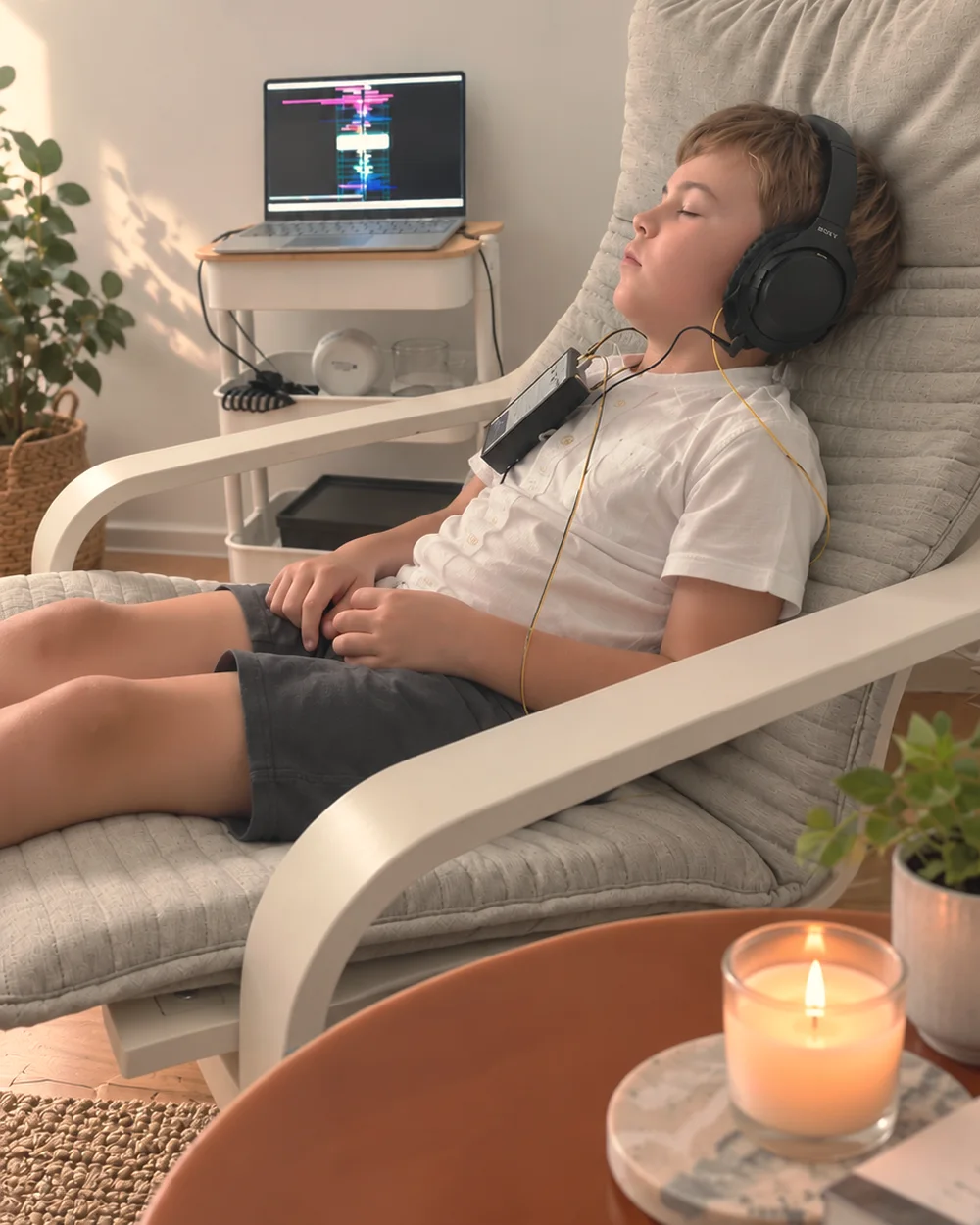
- of music, seated, wearing headphones
- 50 min
- for the whole visit, roughly
- 1–2
- sessions a week
It depends on each child and each adult. What I see in sessions is that in the first three or four sessions the brain gets used to the system, and that the first things to shift are usually sleep and frustration levels, before attention itself.
Between the fourth and tenth sessions come comments like «he’s calmer in the afternoons» or «she did her homework without a fight». From the tenth onwards, those changes hold better between one session and the next. Most people come once or twice a week. I explain it in detail in what neurofeedback sessions are like.
What I won’t promise you
Nobody can guarantee you a result, and be wary of anyone who does. Neurofeedback is training: changes are gradual and everyone responds in their own way. Some children respond very well and others very little.
Nor will it get your child top marks. It works on regulation, not grades. What usually improves first is the atmosphere at home, and that’s worth a great deal.
And if after a few sessions you don’t see anything, I’ll tell you and we’ll talk about it, rather than just adding more sessions.
«I’ve had 20 neurofeedback sessions with Aurélie and I can say it’s been one of the best decisions I’ve made this year.»
FAQ
Does neurofeedback help with ADHD?
Yes. It trains the nervous system’s self-regulation, which is exactly what struggles in attention difficulties, and that’s why it often shows in concentration, impulsivity and above all frustration. It isn’t a medical treatment and doesn’t replace a diagnosis: it works alongside everything else, not instead of it.
Do you need a diagnosis to come?
No need. We work with the person in front of us, not with a label. That said, if you suspect there may be undiagnosed ADHD, it’s worth having a healthcare professional look into it.
Can it be combined with medication?
Yes. Brain training doesn’t interfere with medication. Any change in dosage is always decided by whoever prescribed it, never by us.
From what age?
From around three, as long as the child can sit through the 33 minutes of music in one go. There’s no upper limit: teenagers and adults train too.
Do they have to do anything during the session?
Nothing. No concentrating, no effort, no need to behave. They sit, listen to music and the learning happens by itself. For a child who experiences effort as a battle, this is often a relief.
How many sessions will we need?
It depends on each case. Most people work with 10- or 20-session packages, once or twice a week, because lasting change needs continuity.
You’ll find more answers in the FAQ and the prices under pricing and packages.
Keep reading
Did you recognise yourself, or your child?
Let’s talk, no strings attached. It’s 30 minutes, free of charge: you tell me about the situation and we see together whether this is right for you.
or at info@neuronowak.com