Anxiety: find your calm again with neurofeedback
You’re not overreacting. Your alarm system has been switched on for so long that it’s forgotten how to switch off, and it goes off over things that never used to bother you: an email, a traffic jam, a change of plans.
You can’t get rid of anxiety through willpower, because anxiety doesn’t live in your willpower. It lives in a nervous system that has lost the habit of returning to calm. And that can be trained.
No prior diagnosis neededWithout medicationFrom around age 3Cerrado de Calderón (Málaga) · La Cala del Moral

What usually improves
Day to day
- Less anticipation: no more rehearsing conversations that haven’t happened.
- Reacting less intensely to things that used to set you off.
- Getting back to yourself sooner after a rough patch.
- More clarity to make decisions without going round in circles.
In your body
- Less of a knot in your stomach and less tightness in your chest.
- Less tension in your neck, jaw and shoulders.
- Falling asleep sooner, with a less racing mind.
- Less of that underlying tiredness that sleep doesn’t fix.
If sleep is what you’re struggling with most, the insomnia page covers it in full.
NEURONOWAK is a brain training centre offering neurofeedback in Málaga and La Cala del Moral. Individual, in-person sessions, no prior diagnosis needed and without medication. What follows is what I see in my practice, not a promise.
How it works in the brain
An anxious brain isn’t a broken brain: it’s a brain that switches on well and switches off badly. The alarm goes off when it should, but then it doesn’t come down, and the body stays on guard for hours or days.
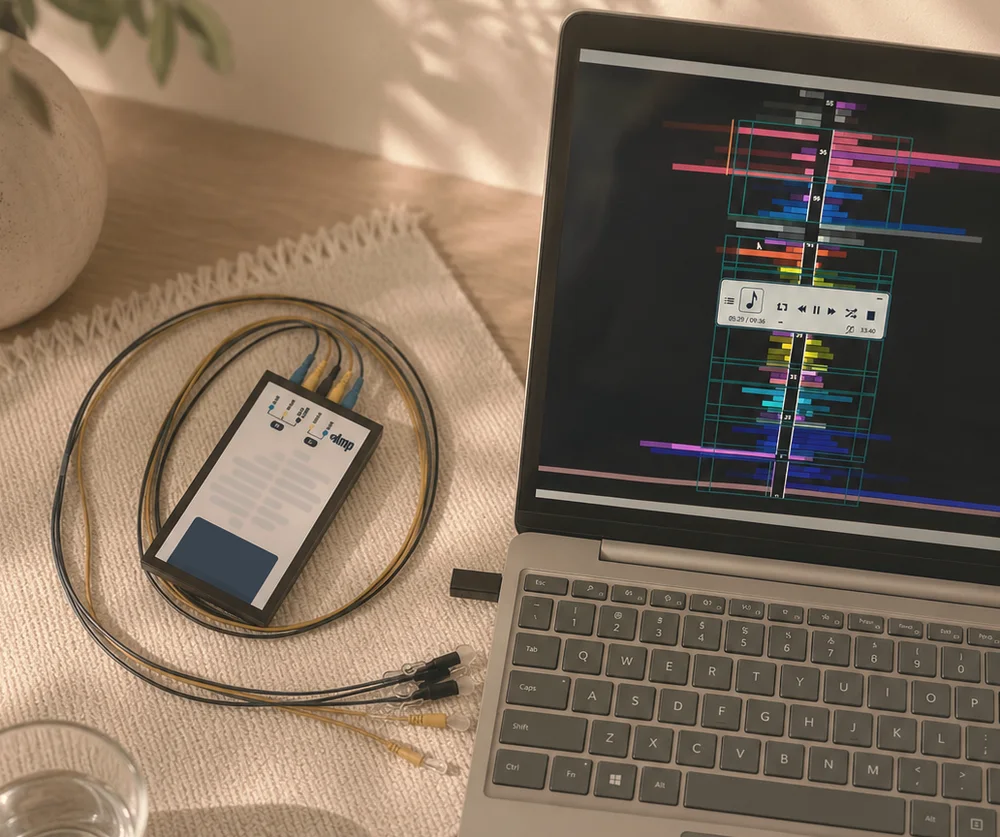
Brain training works right there. The system reads your electrical activity in real time and, every time it detects one of those abrupt shifts, the music you’re listening to pauses for a split second.
That tiny pause is information, not an instruction. Your brain takes it in and adjusts on its own. You don’t have to concentrate, relax on purpose or get it right.
See what a session looks like from the insideA short reel on @neuronowakWatch the reelWhy it doesn’t go away on its own
Because the brain learns from what it repeats, and anxiety repeats a lot. Every time the alarm goes off and nothing bad happens, the system doesn’t conclude «I got it wrong»: it concludes «good thing I was on alert». And it reinforces the pattern.
That’s why understanding it isn’t enough. You can know perfectly well that the email isn’t an emergency and your body still reacts the same way. Understanding travels one road and regulation travels another.
What we train here is the second.
What I see in my practice
Very different people come to me with the same words: «I can’t stop».
- Background anxiety, the kind with no specific cause that’s always there.
- Anticipation: going over what hasn’t happened yet and what already has.
- Panic attacks, with your heart racing and the feeling that something is wrong.
- Social anxiety, the kind where you replay everything you said afterwards.
- Anxiety that shows up in the body first: digestion, jaw, tightness in the chest, and every medical test coming back normal.
I also see sustained mental load, which isn’t exactly anxiety but ends up in the same place. And teenagers, not just adults.
How many sessions you need and when you’ll notice
- 33 min
- of music, seated, wearing headphones
- 50 min
- for the whole visit, roughly
- 1–2
- sessions a week
Most people need between 10 and 20 sessions, at one or two a week.
- First sessions. Sleep and your background level of tension almost always shift before the anxiety itself. It’s a good sign, even if it doesn’t feel like one: it means the system is winding down.
- Between sessions six and twelve. You start hearing things like «I realised I didn’t get worked up». The changes stop depending on how your week has gone.
- From session thirteen onwards. It settles in. It stops being a good patch and becomes your new starting point.
You can see the breakdown and the cost on the pricing and packages page.
What I won’t promise you
- That you’ll stop feeling anxietyThat isn’t the goal, and it wouldn’t be good either: well calibrated, anxiety is useful. What we train is for it to settle back down once it’s no longer needed.
- That it replaces therapyIt doesn’t. The two work very well together, and if you’re in therapy, the work usually goes further.
- That you’ll change your medicationThat’s decided by whoever prescribed it, never by me. The training doesn’t interfere with it.
- That it works the same for everyoneSome people notice a lot, and quickly; others notice little. If nothing shifts after several sessions, I’ll tell you and we’ll stop.
«I came in with anxiety that had worn me out, always on alert, unable to switch off for a single moment.»
FAQ
Does neurofeedback help with anxiety?
It’s one of the most common reasons people come to me. What we train is exactly the ability that fails with anxiety: returning to calm on its own, without you having to try. That said, it’s gradual training, not an anti-anxiety pill: the changes build session by session.
Does it hurt or have side effects?
It doesn’t hurt and has no known side effects. The sensors don’t prick and don’t send anything to the brain. The most that usually happens is you leave feeling a bit sleepy, especially the first few times.
Can I keep taking my medication?
Yes. The training doesn’t interfere with anti-anxiety medication or antidepressants, and any change of dose is decided by whoever prescribed it. Never by me, and never on your own.
Can it be combined with psychological therapy?
Yes, and it’s a combination that works well. Therapy works on what you think and what has happened to you; neurofeedback works on the state you do it from. Many people find that with a better-regulated system, they get more out of therapy.
How many sessions before I notice anything?
Usually something shifts in the first few sessions, almost always in sleep or background tension. Lasting changes come between sessions six and twelve.
What if what I have is panic attacks?
It’s a common reason people come to me. The training doesn’t act in the middle of an attack: it works on the ground they grow from, which is a system on permanent alert. If the attacks are intense or frequent, it’s a good idea for a healthcare professional to assess them too, and I’ll tell you so.
You’ll find more answers in the FAQ and the prices under pricing and packages.
Keep reading
Has your mind been racing for a while?
Let’s talk, no strings attached. It’s a free 30-minute first conversation: you tell me how you’re feeling and we see together whether this is right for you.
or at info@neuronowak.com