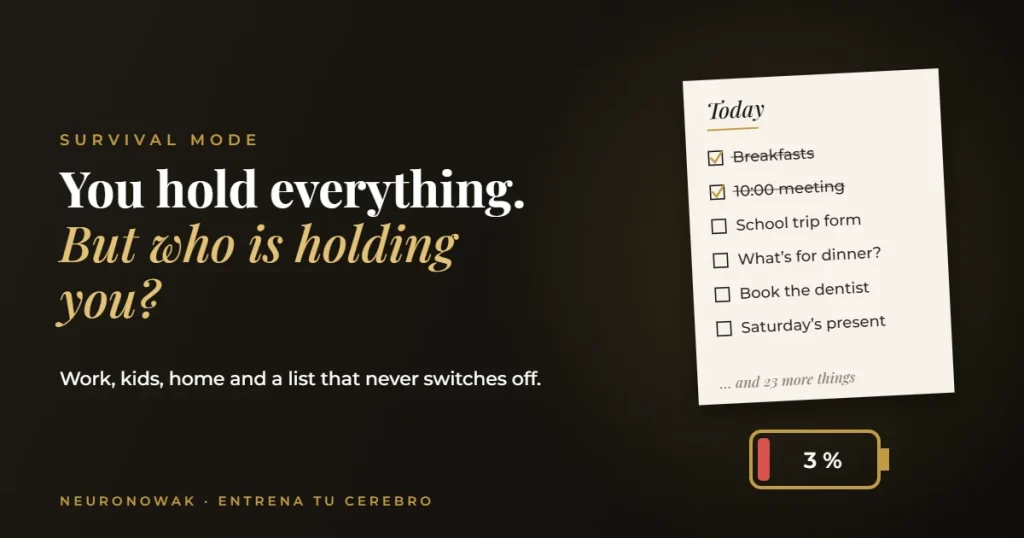
The alarm goes off at 6:45 and your head is already racing ahead: breakfasts, the ten o’clock meeting, the school trip form, what’s for dinner, the dentist appointment you still haven’t booked. Evening comes, you finally sit down, and you can’t remember a single moment of the day that was yours.
If this sounds familiar, you’re not broken and you’re not weak. You’re living in survival mode. And you’re not the only one: it happens to so many of us, women in our forties who work, raise children and run a home all at once.
What living in survival mode means
When the load stays high for months, the brain does what any system under pressure would do: it puts the urgent first and parks everything else. It keeps the alert system switched on so nothing gets dropped, and runs on autopilot to use as little as possible.
The problem is what ends up in “everything else”. What you want, your body, the things you enjoy, the signals telling you to stop. None of it is urgent, so it can always wait until tomorrow.
A few signs you’ve been like this for a while:
You’re tired from everything you carry.
Mental load: what you carry that nobody sees
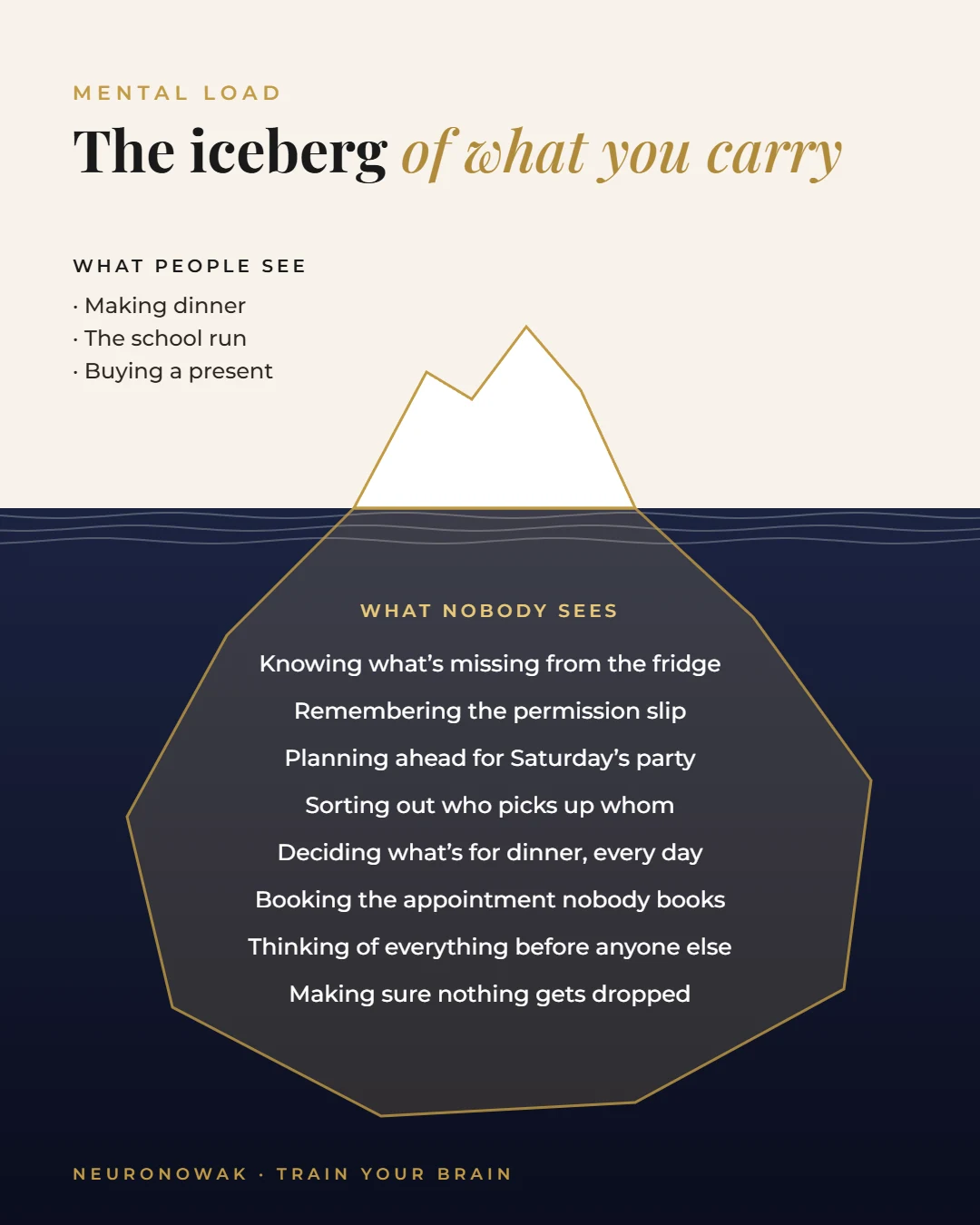
Making dinner is visible. What isn’t visible is knowing what’s in the fridge, what’s missing, who won’t eat what, and what time you need to start so everyone gets to their after-school club. That’s the mental load: not the tasks themselves, but remembering them, anticipating them, deciding and making sure none of them gets dropped.
A study of 393 mothers with partners found that almost 9 in 10 felt solely responsible for organising the family’s schedules. Being mainly responsible for the children’s emotional well-being was linked to feelings of emptiness and lower satisfaction with life and with the relationship (Ciciolla and Luthar, 2019).
Why asking for help is so hard
“It’s quicker if I do it.” “I don’t want to be a bother.” “If I ask, I’ll have to explain, so I might as well do it myself.” We all know these lines by heart. And behind them there’s often something deeper: the idea that asking for help means not coping, and not coping means failing.
We also tend to get something important wrong. In a series of experiments at Stanford University, people who had to ask for a favour expected far fewer people to say yes than actually did: they underestimated by as much as half (Flynn and Lake, 2008). In other words, people are more willing to help you than you think.
How to ask for help without feeling guilty
Getting yourself back
Getting out of survival mode isn’t about doing more things to look after yourself, which just become another item on the list. It’s about giving your nervous system signals that it can lower its guard: enough sleep, time away from screens, a walk with no purpose, half an hour when nobody asks you for anything.
And a note for your forties: the hormonal changes of this stage can also affect sleep and tiredness. If you notice changes that don’t add up, mention them to your doctor. Not everything is stress, and not everything is fixed by pushing through.
Where brain training fits in
What I do is help your brain get back something survival mode has taken away: the ability to move from alert to calm, and back again when needed.
I work with dynamic neurofeedback. You sit down, I place sensors that only read your brain’s activity, and you listen to music for 33 minutes. When the system detects a sudden change, it reflects it back with a tiny break in the sound, and your brain reorganises itself. You don’t have to do anything. No forcing yourself to relax, no telling me your life story. Around 50 minutes when, for once, nobody asks you for anything.
I won’t promise the list will disappear. What we’re aiming for is for you to sleep better again, to slow down and to get back the calm that’s been slipping away. And we track it together, session by session, so you can see it for yourself rather than taking my word for it.
Good to know
Dynamic neurofeedback is training aimed at well-being. It isn’t a medical or psychological treatment and doesn’t replace one. If the exhaustion comes with sadness that won’t lift, losing interest in everything or feeling you can’t go on, talk to your doctor or a psychologist. Asking for that help counts too.
To find out more about how I work with overload, see the mental load page. If nights are what weigh most, read why you wake up at 3 a.m. And to understand why change is so hard even when you know what’s good for you: why you don’t change even when you know what you need to do.
Frequently asked questions
What is survival mode?
It’s how the brain works when the load stays high for a long time: it puts the urgent first, keeps the alert switched on and parks everything else, including your own needs. It isn’t a diagnosis; it’s a way of describing what it feels like from the inside.
Why am I exhausted when I’m not doing anything “big”?
Because tiredness doesn’t only come from what you do, but from what you carry: remembering, anticipating, deciding and making sure everything works out. That mental load is invisible, but it uses up resources all day, even when you’re sitting still.
Is it the same as burnout?
Not exactly. Burnout is described in relation to work, while survival mode usually mixes work, family and home. If exhaustion is affecting you a lot, the best thing is to talk to your doctor to understand what’s going on.
How do I ask for help without feeling guilty?
By asking for specific, whole things, load included, and accepting they’ll be done differently. It helps to know that people are usually more willing to lend a hand than we think.
Does neurofeedback get rid of tiredness?
I won’t promise that. It trains your brain’s ability to regulate itself, to move from alert to calm. Often that shows up first in sleep. We track it together, session by session.
Do I need a diagnosis to start?
No. Dynamic neurofeedback doesn’t need a prior diagnosis or a label. The person who comes to train isn’t a patient.
The NeuroNowak blog
Get every new article in your inbox
One every week or two. How the brain works, sleep, stress and focus, with real science. No spam, and you can unsubscribe whenever you like.