This weekend, lots of people will pay to be scared. Haunted houses, films, costumes. And they’ll love it.
There’s another kind of fear nobody chooses. The one that shows up as you join the motorway, as the lift doors close or as the plane speeds down the runway. It has names many people quietly type into Google: fear of driving, claustrophobia, fear of flying. You know perfectly well it makes no sense. And still it won’t go.
If this is you, you’re not exaggerating and you’re not lacking courage. Irrational fears are how your brain learns to protect you, and understanding that is the first step to stop it calling the shots.
The fear you choose and the fear you don’t
A team of Danish researchers followed 110 people through a haunted house, measuring their heart rate room by room. What they enjoyed most wasn’t the biggest scares or the smallest, but the ones that sat somewhere in the middle: enough to feel it in the body, not so much that it became overwhelming (Andersen et al., 2020).
The difference with fear of driving is simple: in the haunted house you know you’ll get out, and you leave when you want. With a fear you didn’t choose, your brain isn’t so sure.
Knowing it isn’t dangerous isn’t enough
The brain has two routes for responding to something that unsettles it, and they travel at different speeds.
- The fast one. An alarm that goes off in a fraction of a second, before you’ve had time to think. Your heart speeds up, your muscles tense and your body gets ready to escape. It doesn’t reason: it reacts.
- The slow one. The part that weighs things up and tells you “this is an ordinary road, you drive it every week”. It’s right, but it arrives late.
That’s why you can understand perfectly well that a lift is safe and still feel the knot in your stomach. It’s not that you don’t know. It’s that the alarm doesn’t listen to arguments.
How the brain learns to be afraid
Hardly any fear of this kind comes out of nowhere. It usually arrives by one of these routes:
- An experience that frightened you. A sudden emergency stop on the motorway, bad turbulence, being stuck somewhere for a few minutes.
- Something you lived through someone else. Watching your mother grip her seat every time someone overtook teaches more than any explanation.
- What you were told. A news story, an anecdote, a warning repeated over and over.
Then the brain does something very useful in the wild and very awkward in modern life: it generalises. The scare happened on one particular motorway, but the alarm ends up going off on all of them. Then at night. Then whenever you drive alone.
The avoidance trap
The most natural thing to do with something frightening is to avoid it. You take the coast road instead of the motorway, use the stairs, ask someone else to drive. And in that moment you feel relief.
The problem is what the brain learns from that relief: “thank goodness we didn’t go, it was dangerous”. Every time you avoid, the alarm proves itself right, and next time it goes off sooner and louder.
That’s how a small fear starts taking up space: first motorways, then long journeys, then any route you don’t know. Not because you’re becoming more fearful, but because you never give your brain the chance to check that nothing happens.
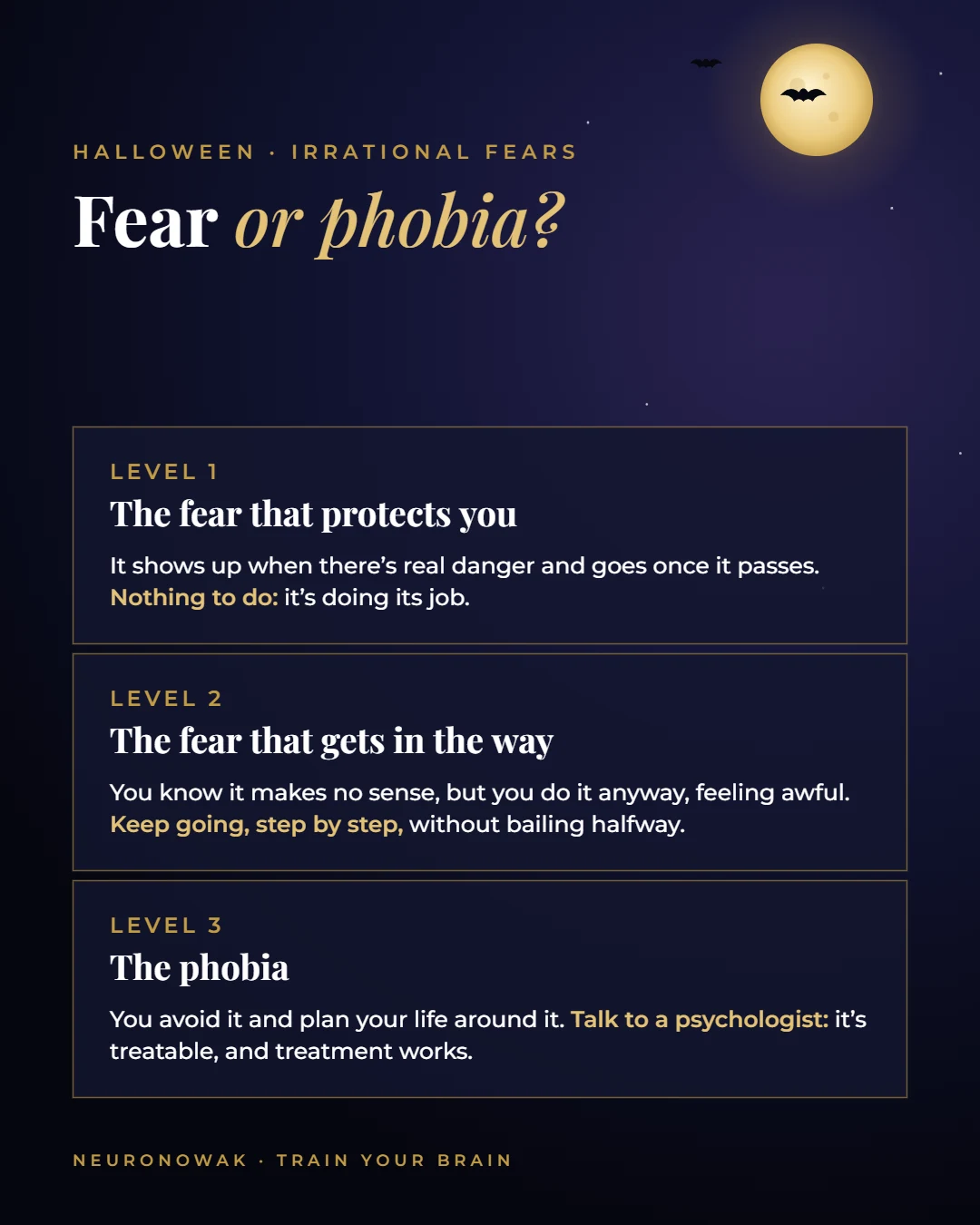
Fear or phobia? Where the line is
Having a fear that makes no sense is very common. When that fear is intense, lasts for months and starts deciding what you do and don’t do, it’s called a specific phobia. That isn’t rare either: a study of more than 120,000 people in 22 countries estimated that around 7% of people have one at some point in their lives (Wardenaar et al., 2017).
| What you notice | What helps | |
|---|---|---|
| The fear that protects you | It shows up when there’s real danger and goes once it passes | Nothing: it’s doing its job |
| The fear that gets in the way | You know it makes no sense, but you do it anyway, feeling awful | Keep doing it, step by step, without bailing halfway |
| The phobia | You avoid it, plan your life around it and feel dreadful just thinking about it | Talk to a psychologist: it’s treatable, and treatment works |
How to get over a fear, step by step
The tool with the strongest scientific backing for fears that have grown too big is gradual exposure: moving towards what frightens you little by little, in steps you can manage, until your brain sees for itself that nothing happens. For phobias, done with a professional, it’s the treatment that has shown the best results in studies (Wolitzky-Taylor et al., 2008).
For everyday fears, three ideas that follow from it:
- Stairs, not leaps. If the motorway frightens you, the first step isn’t a drive to Granada. It’s a short stretch, at a quiet time, with someone beside you. Once that step stops being hard, the next one.
- Stay until it drops. Fear rises, peaks and then starts to fall on its own. If you leave at the peak, your brain only keeps the bad part.
- Don’t wait to stop being afraid before you do it. It works the other way round: the fear drops because you do it.
And a fourth, less well known: look after your sleep. In an experiment at the University of California, after a night without sleep the part of the brain that sets off the alarm reacted around 60% more to unpleasant images (Yoo et al., 2007). A tired brain has a hair-trigger alarm. That’s why some days the same journey feels twice as hard.
Where brain training fits in
Let me be clear: neurofeedback isn’t a treatment for phobias, and if what you have is a phobia, the first step is a psychologist who works with exposure.
What I do is something different. With dynamic neurofeedback, sensors read your brain’s electrical activity while you listen to music, and when the system detects a sudden change, it reflects it back with a tiny break in the sound. You don’t have to do anything. What’s being trained is your brain’s ability to regulate itself: to move from alert to calm and back again.
Many people come because they sleep badly or have spent months with their head racing, and as we talk a fear comes up that has been growing. I won’t promise it will disappear. What we do know is that an alarm living under strain goes off more easily, and that a better-regulated nervous system is a better starting point for anything you want to work on, including with another professional. We track how your sleep and calm change together, session by session.
Shall we talk for 30 minutes?
Tell me what’s going on and I’ll tell you honestly whether brain training makes sense for you, or whether a different kind of help should come first. Free, no commitment, in English.
Message me on WhatsApp Call · +34 650 596 740Good to know
Dynamic neurofeedback is training aimed at well-being. It isn’t a medical or psychological treatment and doesn’t replace one. If a fear is taking a toll on your quality of life, I’d encourage you to talk to a psychologist, and if I can see in our conversation that this is what you need, I’ll tell you.
And if your fears come out mostly at night, when the light goes off, start with why you wake up at 3 a.m. If it’s anxiety that weighs most, here’s how I work with anxiety.
Frequently asked questions
Is it normal to have fears that make no sense?
Yes, very normal. The brain learns fear easily, from a bad experience, from seeing it in someone else or from what we’re told, and then it generalises. Having one says nothing bad about you.
How do I know if my fear is a phobia?
When it’s intense, lasts for months and starts making decisions for you: you avoid situations, plan your life around it or feel dreadful just thinking about it. In that case it’s worth talking to a psychologist.
How do I get over a fear of driving?
Fear of driving is worked on like other fears: by getting back behind the wheel in small steps, first short, quiet journeys with someone beside you, then building up gradually. If you avoid it completely or it limits you a lot, a psychologist trained in exposure can guide you.
Does a fear go away on its own with time?
Sometimes it softens, but if you avoid it, it usually does the opposite: every time you escape, the brain confirms it was dangerous. What helps most is moving towards it gradually, in steps you can manage.
Does neurofeedback cure phobias?
No, and I won’t promise that. For phobias, the approach with the strongest evidence is exposure therapy with a professional. Brain training works on the brain’s ability to regulate itself; it can go alongside, but it doesn’t replace that treatment.
Do I need a diagnosis to start?
No. Dynamic neurofeedback doesn’t need a prior diagnosis or a label. The person who comes to train isn’t a patient.
The NeuroNowak blog
Get every new article in your inbox
One every week or two. How the brain works, sleep, stress and focus, with real science. No spam, and you can unsubscribe whenever you like.