If you have trouble falling asleep, you are probably looking for the answer in bed: another pillow, another herbal tea, another app. Yet how you fall asleep at night is largely decided during the day, and by the state you’re in when you get into bed after several bad nights. Here’s why, and 5 keys to change it.
You switch off the light. You close your eyes. Nothing. You toss and turn, roll over, go back over what you didn’t get done today and what’s waiting for you tomorrow. Half an hour goes by. An hour. You’re tired, but sleep just won’t come.
Fear of not sleeping: when bed turns into an exam
If it happened last night, and the night before, and last week, something shifts without you noticing: you no longer go to bed relaxed. You go to bed afraid it will happen again.
The loop that repeats every night
The more you dread it, the harder it gets
Your brain does what it knows how to do: if something worries it, it stays on guard. And sleep, by nature, comes when you’re not chasing it. Sleep researchers put it this way: the more attention and effort you put into falling asleep, the harder it becomes (Espie et al., 2006).
It’s not that you don’t know how to sleep.
Your brain has learnt to link bed with worry.
Every bad night strengthens that link a little, and the next one is a little harder. The good news is that what has been learnt can also be retrained. And it doesn’t only happen in bed: your brain has no off switch, it needs the right signals throughout the day.
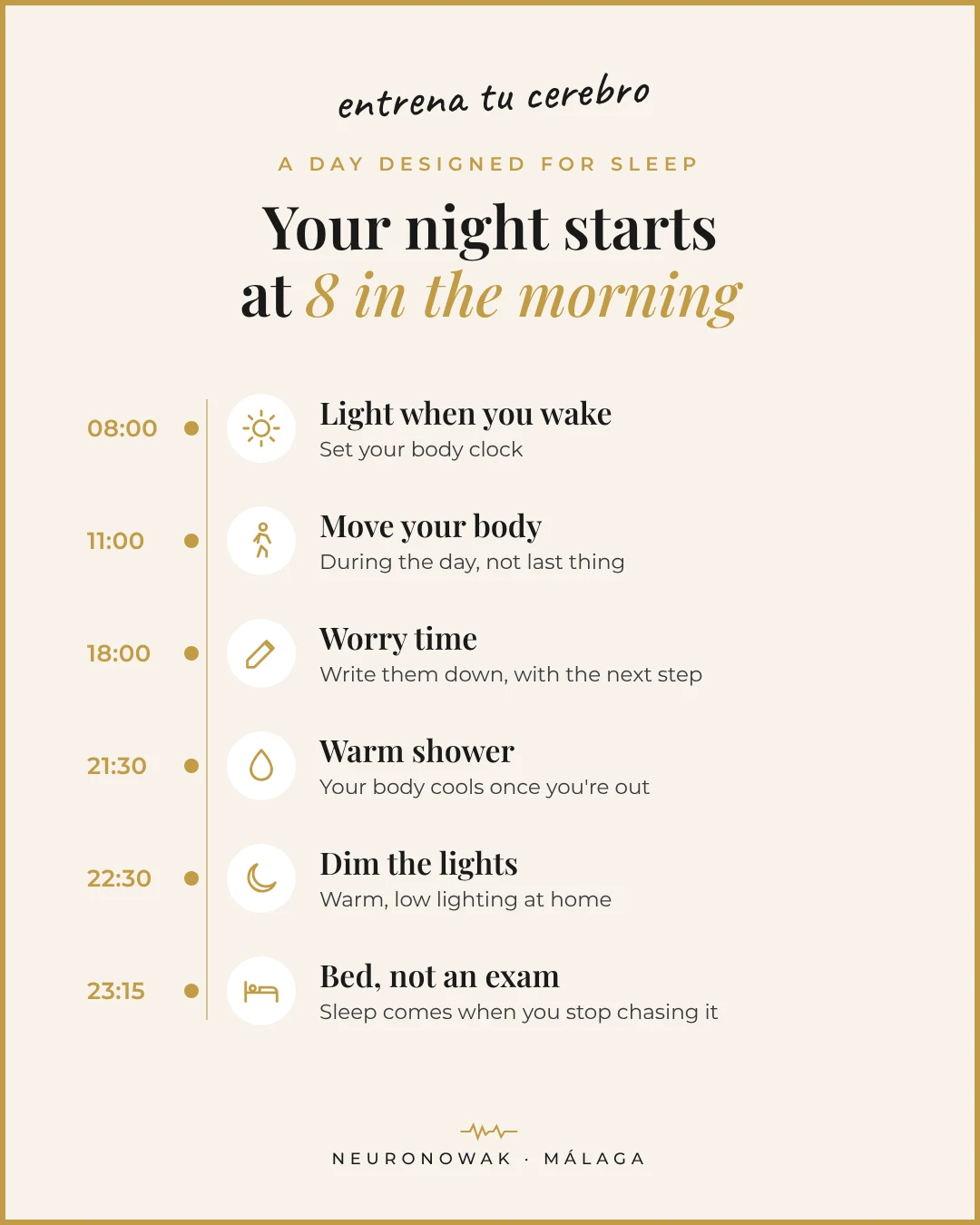
5 keys to sleep better, starting in the morning
Light in the morning, dim light at night
Your body clock sets itself by light. Natural light early in the day tells your brain “the day has started”, and many hours later that marks the moment it begins getting ready for sleep.
What to do: get some outdoor light within the first hour after waking (a short walk, your coffee by the window or on the terrace). At night, the opposite: warm, low lighting at home from dinner onwards.
Move your body, but not last thing
Regular exercise is linked to falling asleep sooner and better sleep quality (Kredlow et al., 2015). You don’t need a gym: a brisk walk counts.
What to do: move for a while every day, ideally in the morning or mid-afternoon. Intense exercise right before bed revs your body up just when it should be winding down.
Don’t save your worries for the pillow
If there’s no time to think during the day, your mind grabs the first quiet moment it finds: the one in bed. Including the worry about not sleeping.
What to do: set aside 10 to 15 minutes in the late afternoon, always at the same time, for your worries. Write them down and, next to each one, the next small step. When they come back at night, you can tell yourself: “That already has its place, tomorrow at six.”
Help your body cool down
To fall asleep, your body temperature needs to drop slightly. A warm shower or bath one to two hours before bed helps you fall asleep sooner: once you’re out, your body cools, and that signals it’s time to rest (Haghayegh et al., 2019).
What to do: a warm shower (pleasant, not scalding) after dinner, and a cool, well-aired bedroom.
If none of this is enough, train your brain
Some people do everything right and still can’t fall asleep. It isn’t a lack of discipline. It’s a brain that has got used to running fast and that, after so many bad nights, arrives in bed already on guard. More on that just below.
Neurofeedback for better sleep: teaching your brain to lower its guard
What I do in my practice is help your brain recover something all those bad nights have taken away: the ability to move from alert to calm, including when you get into bed.
I work with dynamic neurofeedback. You sit down, I place sensors that only read your brain’s activity, and you listen to music for 33 minutes. When the system detects a sudden change, it reflects it back with a tiny break in the sound, and your brain reorganises itself. You don’t have to do anything. Not even try to relax, which is exactly what doesn’t work for sleep.
I won’t promise you eight hours of sleep from the first session. What we’re aiming for is for your brain to stop arriving in bed on guard. And we measure it together, session by session, so you can see it for yourself rather than take my word for it.
How is your sleep right now?
The sleep test takes two minutes and gives you recommendations for your situation. And if you’d rather talk it through, I offer a free 30-minute conversation, with me personally, in English.
Take the sleep test Message me on WhatsAppGood to know
Dynamic neurofeedback is wellbeing-oriented training. It is not a medical or psychological treatment and does not replace one. If your insomnia has lasted more than three months or is affecting your daily life a lot, talk to your GP as well: the European insomnia guideline recommends cognitive behavioural therapy as the first option (Riemann et al., 2023).
Is your problem not falling asleep but waking in the night? That’s a different story, with its own article: why you wake up at 3 in the morning. And to see how I work with sleep, here’s the insomnia page.
You’ll find me in Cerrado de Calderón (Málaga) and La Cala del Moral, or by video call.
Frequently asked questions
Why do I struggle to fall asleep when I’m exhausted?
Because being tired isn’t the same as having a brain that’s ready to sleep. If it reaches the evening revved up or worried, the tiredness is there, but the alertness wins. That’s why what you do during the day matters so much.
Is it normal to be afraid of not sleeping?
Yes, and it’s very common after several bad nights. The problem is that this fear keeps the brain on guard right when it should be letting go, so the loop feeds itself.
What should I do if I’ve been in bed for a while and can’t sleep?
We cover this in detail in the article on waking up at 3am: it works just as well when you can’t drop off. The idea is not to stay there wrestling with the pillow.
Will neurofeedback make me sleepy?
No. It isn’t a sedative and it doesn’t induce sleep. It trains your brain’s ability to regulate itself, to move from alert to calm. Often that shows up first in how you rest, and we track it session by session.
Do I need a diagnosis to start?
No. Dynamic neurofeedback doesn’t need a prior diagnosis or label. The person who comes to train is not a patient. People usually start with 10 sessions.
The NeuroNowak blog
Get every new article in your inbox
One every week or two. How the brain works, sleep, stress and focus, with real science. No spam, and you can unsubscribe whenever you like.