Why you don’t change even when you know what you need to do has an answer that has nothing to do with willpower: the brain has two ways of deciding and, under stress, autopilot wins. In this article I’ll tell you what neuroscience says, how long a new habit really takes (it isn’t 21 days), three things that actually help and where brain training fits in.
You know you should go to bed earlier. That your phone shouldn’t be the last thing you look at at night. That stopping for ten minutes at midday would do you good. You know it perfectly well. And you don’t do it.
And then comes the second part, the one that weighs most: thinking you lack willpower, that you’re a mess or that you’re “hopeless.” That isn’t it. It’s how your brain works, and understanding it changes quite a bit how you go about trying.
Habits and the brain: your brain has two ways of deciding
Neuroscience describes two systems that work at the same time when you act.
- The goal-directed system. It’s the one that thinks: “I want to sleep better, so tonight I’ll go to bed at eleven.” It weighs consequences, compares options and decides. It works very well, but it uses a lot of resources.
- The habit system. It’s the autopilot: in a familiar situation, it repeats what it did the other times, without asking. Sofa, phone, one more episode. It’s fast and uses almost nothing.
Your brain doesn’t have an autopilot out of laziness. It has one because it would be impossible to live deciding everything from scratch. The problem is that the autopilot doesn’t know what you want now: it only knows what you did before.
Stress and habits: why autopilot wins under stress
Here’s the part almost nobody talks about. In 2009, two German researchers, Lars Schwabe and Oliver Wolf, asked a group of people to learn a simple task and then changed the rules. Some of the group had first been put through a stressful situation; the others hadn’t.
The stressed participants kept repeating what they had learned, even though it no longer worked. Those who weren’t stressed adapted to the change (Schwabe and Wolf, 2009).
Translated into real life: the more loaded you are, the more your habits decide for you. Right in the weeks when you most need to change something, your brain falls back on what it knows. Not because you don’t know what’s good for you, but because it has no resources left to step off the usual path.
How long a new habit really takes
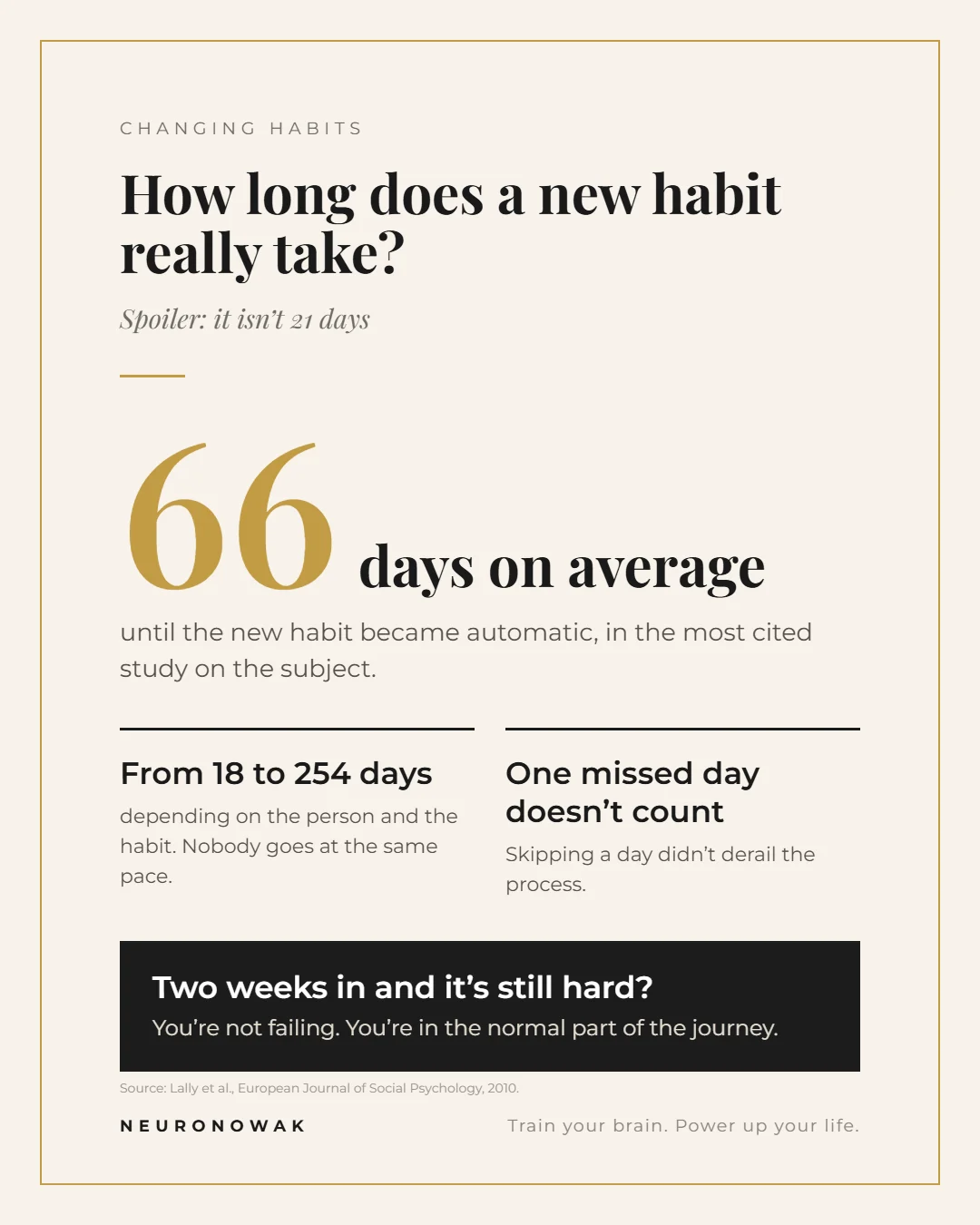
You’ve probably heard about the 21 days. It has no basis. The most cited study on the subject followed 96 people trying to adopt a new habit, like drinking water with a meal or going for a walk (Lally et al., 2010).
- On average, the habit took 66 days to become automatic.
- Depending on the person and the habit, it took between 18 and 254 days.
- And a finding that takes a lot of pressure off: skipping a day didn’t derail the process.
In other words: if you’re two weeks in and it’s still hard, you’re not failing. You’re in the normal part of the journey.
How to change a habit: three things that actually help
None of them costs money, and all three have something in common: they don’t depend on gritting your teeth.
- Lower your alert level first. Asking a brain that’s racing to change is asking it to do what it does worst in that state. Before trying the new habit, anything that brings you down a notch (breathing slowly for a couple of minutes, stepping outside, closing the screen) gives the deciding system some room back.
- Change the context, not your willpower. Autopilot responds to cues: the sofa, the charger on the nightstand, the time of day. Move the cue and the habit loses strength. If your phone charges in the kitchen, there’s nothing to resist at midnight.
- One change, always at the same moment. One small change repeated beats five at once. And tie it to something you already do: “after I brush my teeth, I turn off my phone.”
Where brain training fits in
What I do in my sessions isn’t teaching you habits or giving you willpower. It’s something else: training your brain’s ability to regulate itself, to move from alert to calm and back again more easily.
I work with dynamic neurofeedback. Sensors read your brain’s electrical activity while you listen to music, and when the system detects an abrupt shift, it feeds it back to you instantly with a brief pause in the sound. You don’t have to do anything: no concentrating, no effort, no getting it right. That’s why it fits exactly with what this article describes: it isn’t one more thing that demands willpower.
I won’t promise you’ll change your habits by coming to train. What we do know, from what you’ve read above, is that a less loaded brain has more room to step off autopilot. That room is what we work on, and we track together, session by session, how your rest, vitality and calm evolve.
Shall we talk for 30 minutes?
Tell me what you’re finding hard to change and I’ll explain, with no commitment, whether brain training makes sense for you. It’s free.
Message me on WhatsApp Call · +34 650 596 740Worth knowing
Dynamic neurofeedback is training focused on well-being. It isn’t a medical or psychological treatment and doesn’t replace one. If what’s stopping you from changing is something that needs other help, I’ll tell you and point you in the right direction.
If the habit you’re struggling with has to do with sleep, start with the sleep test, which takes a minute and a half, or with why you wake up at 3 a.m.. And if you’d like to know what a session is like and what it costs, it’s all in how much neurofeedback costs in Málaga.
Aurélie · NeuroNowak · Train your brain. Power up your life.
Frequently asked questions
If I don’t change, does it mean I lack willpower?
No. Most of what we do during the day is decided by the habit system, which is automatic. And under stress that system carries even more weight. It isn’t a flaw of yours: it’s how the brain works when it’s overloaded.
How long does it take to change a habit?
In the most cited study, an average of 66 days, with big differences between people: from 18 to 254. And skipping a day didn’t derail the process.
Does neurofeedback change my habits?
Not directly, and I won’t promise that. What it trains is your brain’s ability to regulate itself, to move from alert to calm. And a less loaded brain has more room to step off autopilot.
Do I need a diagnosis to start?
No. Dynamic neurofeedback doesn’t need a prior diagnosis or label. Someone who comes to train isn’t a patient.
The NeuroNowak blog
Get every new article in your inbox
One every week or two. How the brain works, sleep, stress and focus, with real science. No spam, and you can unsubscribe whenever you like.